
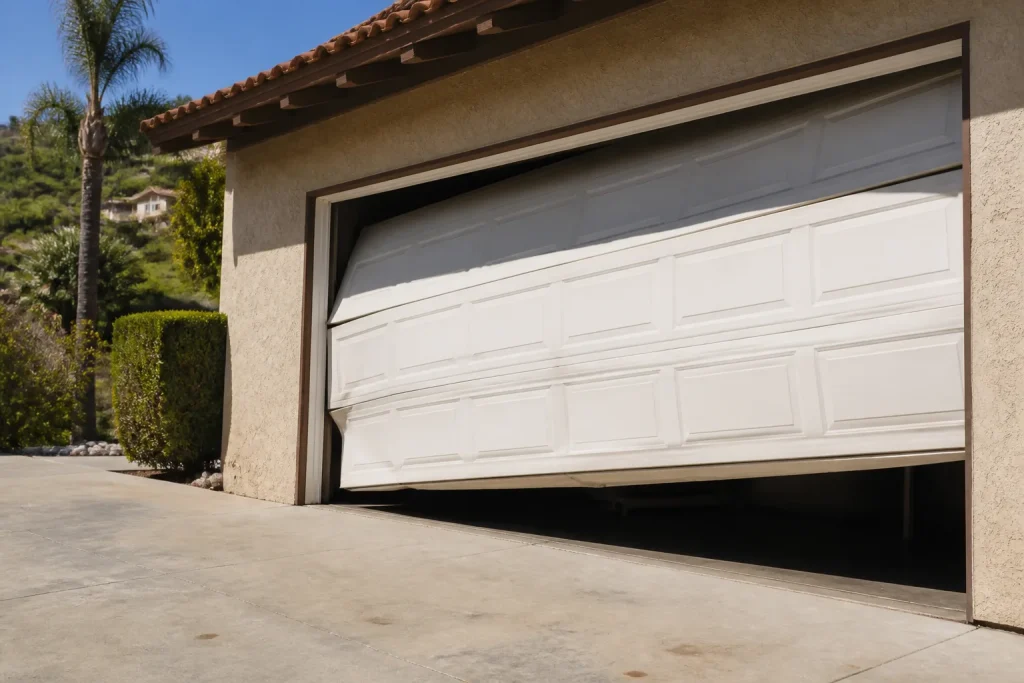
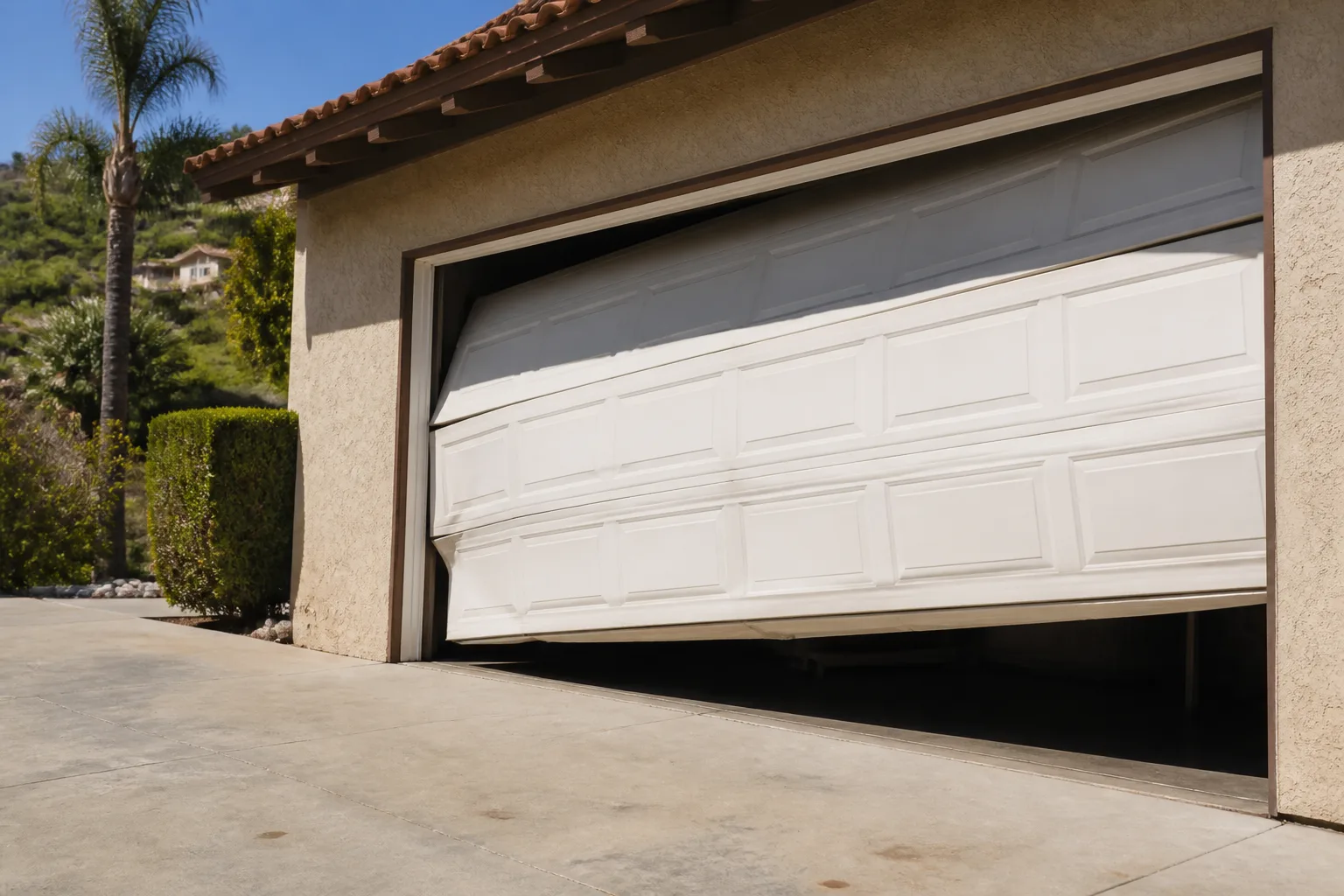
5 Mistakes to Avoid With Garage Door Parts
A torsion spring rated for 10,000 cycles from an OEM supplier and one rated for 10,000 cycles from an unverified overseas manufacturer are not the same part. The wire diameter, coil count, and steel grade all determine whether that rating is real or printed on a sticker. In 15 years of field work across San Diego, we’ve seen homeowners waste money on “spec-matched” knockoffs that failed within months, and we’ve seen worse — doors that came down hard because someone trusted a label.
If you’d rather not sort through part numbers and calipers yourself, call us at (844) 681-4789 for a free estimate. Eric Vasquez, the owner, still supervises every job personally.
1. Trusting the Sticker: How Fake Springs Fool Homeowners
Here’s what most people don’t know: two springs can both say “0.250 wire, 2-inch ID, 10,000 cycles” and be completely different animals. The critical difference is in the wire diameter tolerance and the actual steel grade used.
We measure every spring we remove with a wire gauge. A legitimate OEM spring from a supplier like Clopay or Amarr will hit its stated diameter within two thousandths of an inch. The knockoffs we pull out of garages in Mira Mesa and Clairemont? We’ve measured wire that’s three to four thousandths under spec. Doesn’t sound like much until you do the math: that thinner wire carries the same door weight through the same cycle count, but with significantly less fatigue resistance. The spring fails early, often catastrophically.
The other tell is coil count. A 10,000-cycle spring needs enough active coils to distribute that fatigue. Cut the coil count by even half a turn to save steel cost, and you’ve got a spring that’ll make it to maybe 6,000 cycles before it snaps. When we replace springs in San Diego homes, we always check the original manufacturer’s spec sheet against what we’re installing. No spec sheet, no install.
What to check:
- Measure wire diameter with a proper gauge, not a ruler
- Count active coils and compare to OEM documentation
- Buy from a supplier who can trace the spring back to a known mill
We pulled a spring out of a garage over in Scripps Ranch last month that looked perfect — clean paint, clear label — but the wire was soft enough to score with a fingernail. Real spring steel doesn’t do that.
2. The Cable-and-Drum Mismatch Nobody Talks About
Cable diameter and drum groove width are married. Change one without checking the other, and you’ve created a wear pattern that frays cables from the inside out.
Standard residential cables run 1/8-inch diameter, matched to drums with grooves cut to that width. But we’ve seen homeowners in San Diego swap in 3/32-inch cables because they were cheaper or available faster. The cable sits loose in the groove, rolls unevenly, and develops a corkscrew wear pattern where the strands rub against the drum flange. Eighteen months later, the cable frays at a point that never touched the door, and the homeowner thinks they got a bad batch.
The reverse happens too: a 5/32-inch cable forced into a 1/8-inch groove pinches at the edges, crushes the inner strands, and fails from compression fatigue. We’ve replaced both scenarios in Point Loma and Encinitas.
The failure mode is specific. You won’t see outer wear. The cable looks fine until it doesn’t, and when it goes, the door drops unevenly and jams in the track. If you’re lucky, the safety cable catches it. If you’re not, you’ve got a bent track or worse.
When to call a pro: If you don’t have the original drum part number and a caliper to check groove width, this isn’t a guess-and-check job. A mismatched cable will fail. It’s not an “if.”
3. Residential Rollers on a Heavy Door
Standard 2-inch nylon rollers are rated for doors up to about 150 pounds. A solid wood door, a heavily insulated double door, or any door with glass panels can push 250 to 350 pounds. Put residential-grade rollers under that load, and you’re not just wearing out bearings faster — you’re distorting the track geometry over time.
Here’s what happens in slow motion. The roller flexes under load, especially at the horizontal curve. That flex lets the door settle slightly off-plumb with each cycle. The rollers start riding the track edges instead of the centers. Six months in, you’ve got metal-on-metal contact. Twelve months, the track walls are peened and galled. Eighteen months, the door binds, the opener strains, and the homeowner calls us thinking they need a new opener.
We’ve fixed this exact progression in San Diego garages from La Jolla to National City. The fix is always the same: replace the rollers with 11-ball steel or heavy-duty nylon rated for the actual door weight, and often straighten or replace the track sections that got damaged.
The kicker? Heavy-duty rollers cost maybe $8 more per roller. The track repair costs ten times that.
Related services in San Diego: If your door is getting noisy or sticking, our Garage Door Repair in San Diego service includes full weight assessment and roller matching.
4. Skipping Weather Seal During Panel Work
This one’s simple math. The weather seal on your bottom panel costs maybe $15 in material. Replace it during a bracket or panel service call, and the labor is essentially free — you’re already disassembling that section. Come back six months later for a separate seal replacement, and you’re paying for a full service call minimum.
But the real mistake isn’t just economic. A deteriorated seal lets water wick up into the bottom panel. In San Diego’s coastal neighborhoods, that moisture brings salt. Steel panels rust from the bottom up. Wood panels delaminate. We’ve replaced bottom panels in Ocean Beach and Pacific Beach that were structurally compromised because a homeowner — or a rushed technician — skipped a $15 seal during a bracket repair.
The seal also affects door balance. A water-logged, compressed seal adds weight to the bottom of the door. The spring was calibrated for the original weight. Even five pounds of difference changes the cable tension and opener load.
Our rule: if we’re touching the bottom panel or the brackets that hold it, the seal gets inspected. If it’s cracked, hardened, or compressed below half its original height, it gets replaced. No exceptions.
5. Using Original Spring Math on a Modified Door
This is the mistake that scares us most, because it looks correct. The door has a sticker with the original spring specs. The specs are still legible. So you order the same spring.
But the door isn’t the same door anymore.
We’ve seen this in San Diego’s older neighborhoods — Kensington, North Park, Golden Hill — where homeowners have converted garages to workshops, added insulation, or hung storage racks on the back of the door. Every modification changes the door weight. Every pound of added weight changes the spring torque requirement.
The standard calculation is WERD: Weight per square foot, plus Endload (track type), plus Radius (drum size), plus Door height. Change the weight without recalculating, and you’re running a spring that’s either under-torqued or over-torqued.
Under-torqued: the opener works harder, cables go slack on the up-cycle, door drifts closed. Over-torqued: the door jumps on opening, cables over-tension, hardware stress cracks the end bearings.
We weigh every door we service. Actual scale weight, not guesswork. A Clopay insulated door that left the factory at 185 pounds can hit 220 after a homeowner adds 2-inch foam board and plywood backing. That’s a different spring. Period.
Key Takeaways
- Measure spring wire diameter with a gauge — labels lie, steel doesn’t
- Match cable diameter to drum groove width exactly
- Rate rollers to actual door weight, not “standard residential”
- Replace weather seal any time you’re servicing the bottom panel
- Weigh modified doors and recalculate spring specs — never trust the original sticker blindly
The Bottom Line
The garage door parts market has never been more accessible and never been more dangerous to navigate. Amazon, big-box stores, and bulk suppliers will sell you something that looks right and fits in the same holes. What they can’t sell you is the field experience to know why it still won’t work.
At Cobalt Garage Door San Diego, we’ve built our business on the opposite approach. Eric Vasquez, the owner, is in the field on jobs, not behind a desk approving invoices from afar. That 15 years, one trade focus means we’ve seen these five mistakes — and dozens more — play out in real San Diego garages. Our Garage Door Installation in San Diego and Garage Door Opener in San Diego services follow the same standard: measure twice, verify specs, install once.
If you’re staring at a part number and wondering whether it’s the right one, or if you’ve already installed something that’s not performing, call (844) 681-4789 for a free estimate. We’ll tell you exactly what you’ve got and what it should be.
Frequently Asked Questions
Measure the wire diameter with a proper spring gauge and compare it to the manufacturer’s spec sheet. Counterfeit springs often run undersize by several thousandths of an inch and use softer steel that scores easily. If you don’t have the original specs, call (844) 681-4789 — we can identify most springs by measurement and end configuration.
A cable that’s too small for the drum groove develops internal fraying from uneven rolling and fails without visible warning. A cable that’s too large gets crushed in the groove and fails from compression. Either mismatch risks an uncontrolled door drop. We match cables to drum part numbers on every job — it’s not a place for approximation.
Only if you know your door’s actual weight and the roller’s load rating. Standard nylon rollers fail prematurely under heavy doors and distort the track over time. We weigh doors and spec rollers accordingly — for most San Diego homes with insulated or wood doors, we upgrade to 11-ball steel or heavy-duty nylon.
Repeated part failures usually point to a system mismatch: wrong spring torque, wrong cable size, wrong rollers, or added door weight that was never recalculated. One bad part stresses everything upstream and downstream. We diagnose the root cause rather than swapping the same failed component repeatedly.
Written by Eric Vasquez, Owner / Field Supervisor at Cobalt Garage Door San Diego, serving San Diego since 2011.
Need Garage Door Help?
Call Cobalt Garage Door San Diego — licensed & insured, available 24/7 in San Diego.
(844) 681-4789