
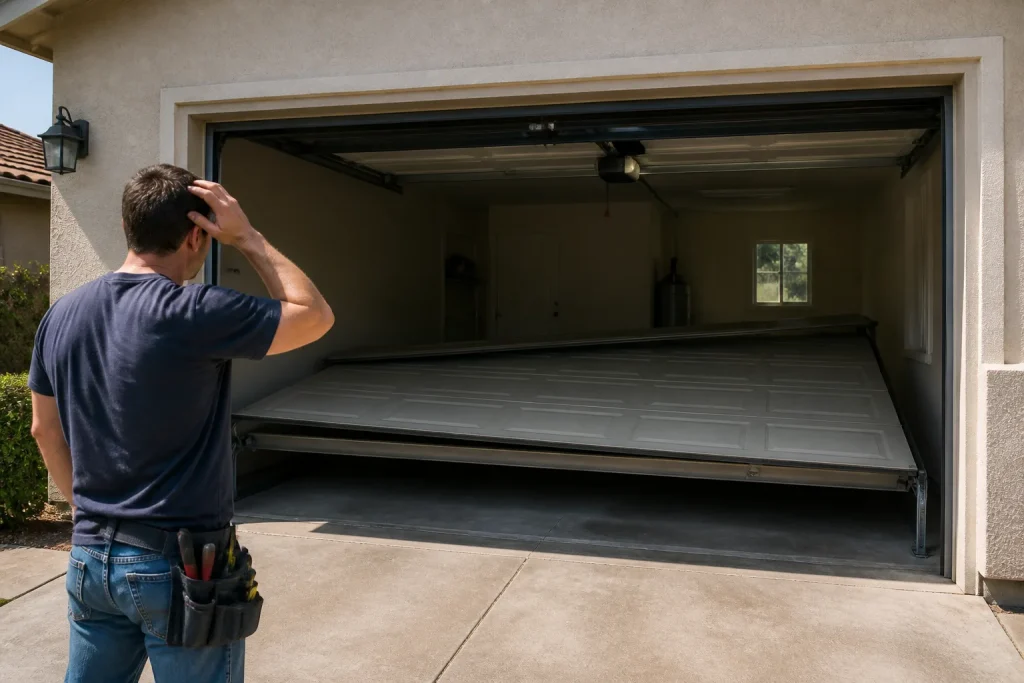
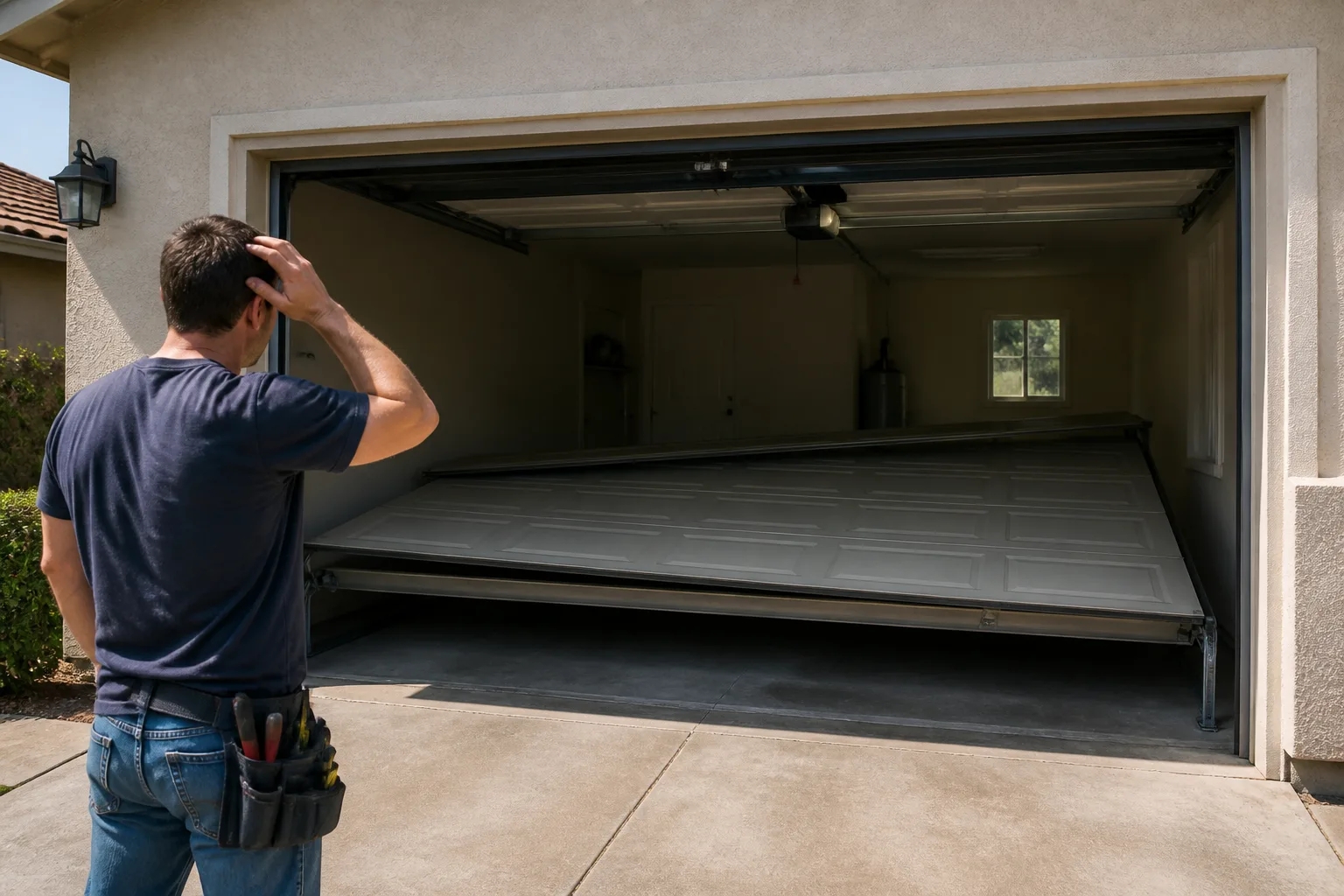
5 Mistakes to Avoid With Garage Door Opener
The most expensive garage door opener mistakes aren’t from the unit failing on its own — they’re from how homeowners adjust, accessorize, or ignore early warning signs. In 15 years of opener service calls across San Diego, we’ve seen the same five self-inflicted errors turn a $150 adjustment into a $600 replacement. If you’d rather not risk it, call us at (844) 681-4789 for a free estimate.
Mistake 1: Over-Tightening the Travel Limits
This is the single most common opener failure we see in the field, and it’s almost always after a DIY adjustment.
When a door starts stopping short of the floor or reversing before it hits the header, homeowners naturally reach for the travel limit screws on the opener housing. The problem is turning them too far. Over-tightened limits force the motor to strain against a physical stop it can’t reach. The motor overheats, the nylon drive gear strips, and within six months you’ve voided the manufacturer warranty and need a full gear-and-sprocket replacement or a new opener entirely.
Here’s what happens mechanically: the opener thinks the door hasn’t reached its programmed endpoint, so it keeps applying torque. That torque has to go somewhere. On chain-drive units, it chews through the nylon gear. On belt-drive systems, it can snap the trolley or damage the rail.
We pulled one out of a garage over in Clairemont last month where the homeowner had cranked both limits to their maximum. The gear was ground down to nubs and the motor smelled like burnt toast. A $180 limit adjustment became a $480 opener swap.
The right approach is quarter-turn adjustments, testing between each one, and stopping the moment the door seals properly. If you’re not confident in that process, it’s worth the service call.
Related: Garage Door Opener in San Diego
Mistake 2: Using WD-40 on the Drive Rail
WD-40 is not a lubricant. It’s a water displacer and light solvent. Using it on your opener’s rail or chain accelerates wear instead of preventing it.
We’ve opened up Genie screw-drive units in San Diego where the rail was coated in WD-40 residue. The solvent had stripped the factory grease from the nylon drive carriage, and the metal-on-metal contact had scored the rail. The homeowner thought they were maintaining it. They were actually sandpapering the internals every cycle.
Here’s what actually works:
- Chain or screw drives: White lithium grease or manufacturer-recommended lubricant on the rail, applied lightly every 6 months
- Belt drives: Typically no rail lubrication needed — check your manual
- Roller hinges and bearings: Silicone-based spray, never petroleum-based products that attract grit
San Diego’s coastal air adds salt moisture to the equation, especially in garages near the bay or ocean. The wrong lubricant mixed with salt air is a recipe for corrosion. We’ve replaced more opener rails in Point Loma and Pacific Beach than inland neighborhoods for exactly this reason.
When to call a pro: If your opener is making grinding noises, stopping mid-travel, or the rail shows visible scoring, the damage may already be done. We can assess whether a rail replacement or full unit swap makes more sense.
Mistake 3: Ignoring Force Sensitivity After Spring Work
This one gets missed by almost everyone, including some generalist handymen who shouldn’t be touching garage doors.
Your opener’s force sensitivity settings tell the motor how much resistance is normal. When springs are replaced or adjusted, the door’s weight balance changes. A properly balanced door might weigh 8–10 pounds; an unbalanced one can put 50+ pounds of load on the opener. If the force settings aren’t recalibrated, the opener either works too hard (burning out the motor) or doesn’t detect an obstruction (safety hazard).
After any spring replacement — extension or torsion — the force settings need testing and adjustment. The standard check is the 2×4 test: place a board flat on the floor, close the door, and verify it reverses on contact. If it doesn’t, the down-force is too high.
In our experience across San Diego, this is where the single-trade focus matters. A generalist might swap springs and call it done. We spend the extra 10 minutes to rebalance the door, test the safety reverse, and dial in the force settings. That 10 minutes is what separates a 15-year opener from a 3-year replacement.
Related: Garage Door Repair in San Diego
Mistake 4: Daisy-Chaining the Opener Outlet
Your garage door opener draws dedicated amperage, especially on startup. Plugging it into a shared circuit with compressors, space heaters, or holiday light displays creates voltage drop that damages the logic board over time.
We’ve traced opener failures in San Diego garages to:
- Christmas light strings plugged into the same outlet
- Air compressors cycling on while the door operates
- Freezers or refrigerators sharing the circuit
- Extension cords running multiple tools
The symptoms are intermittent and frustrating. The opener works fine in the morning, fails in the evening when lights are on, or randomly loses its travel memory. Homeowners replace remotes, reprogram keypads, even swap the whole unit — when the real fix is a dedicated 15-amp circuit or at minimum, stopping the daisy-chain.
Older San Diego homes, especially in neighborhoods like North Park or South Park with original 1960s wiring, are particularly susceptible. The electrical code has evolved, but the garage outlet setup often hasn’t.
If your opener behaves erratically and you can’t isolate the cause, an electrician or a garage door tech with electrical troubleshooting experience can sort it out. At Cobalt, we’ll tell you straight if the fix is in our wheelhouse or if you need an electrician first.
Mistake 5: Leaving the Default Keypad Code
Older Chamberlain and LiftMaster keypad models shipped with default codes that are publicly documented in manuals available online. If you never changed yours, anyone with a search engine and 30 seconds of patience can open your garage.
This isn’t theoretical. We’ve responded to calls in San Diego where homeowners discovered their garage had been accessed — nothing stolen, but clear signs of entry. In one case in Mira Mesa, the culprit was a former tenant who still knew the default code from a unit installed in 2017.
Here’s what to check:
- Keypads manufactured before 2013 often have 4-digit factory defaults (commonly 0000 or 1234 variations)
- Even newer units should have their codes changed at installation — many installers skip this step
- Wireless keypads on detached garages or guest houses are especially vulnerable
- If you’ve lost track of who has your code (past dog walkers, contractors, house sitters), change it
Changing the code takes under two minutes with the learn button. If your manual is long gone, we service Chamberlain, LiftMaster, Genie, and most major brands — we can walk you through it or handle it on a service call.
Key Takeaways
- Travel limit adjustments should be quarter-turn increments — over-tightening destroys the motor
- WD-40 is not a lubricant; use white lithium grease or manufacturer-specified products
- Always recalibrate force sensitivity after any spring work
- Keep the opener on a dedicated circuit, not shared with high-draw appliances
- Change default keypad codes, especially on older Chamberlain and LiftMaster units
The Bottom Line
Most opener failures we see in San Diego aren’t from defective units — they’re from preventable mistakes that compound over months. The good news is that a quick service call often catches these issues before they become expensive problems. If you’re in San Diego and want your opener checked by someone who’ll actually show up and tell you the truth about whether you need work, Cobalt Garage Door San Diego offers free estimates. Call (844) 681-4789 and ask for Eric.
Frequently Asked Questions
Most opener repairs in San Diego run between $150 and $350, depending on whether it’s a limit adjustment, gear replacement, or logic board issue. Full opener replacement typically ranges from $450 to $850 installed, including a mid-range belt-drive unit. Call (844) 681-4789 for an exact quote — estimates are free.
You can, but quarter-turn adjustments with testing between each change is critical. Most homeowners turn the screws too far, which strips the drive gear and voids the warranty. If your door isn’t sealing or is reversing unexpectedly, a professional adjustment is usually the safer $150 spend versus a $600 replacement.
Intermittent operation usually points to voltage fluctuation from shared circuits, failing safety sensors, or remote signal interference. Check whether the problem happens when other garage appliances are running. If it’s random, the logic board may be failing from past voltage drops. We can diagnose this in about 20 minutes on-site.
For San Diego’s climate, a professional inspection every 12 to 18 months catches wear before it fails. Salt air near the coast accelerates corrosion on chain and screw-drive rails. Annual lubrication, balance testing, and safety reverse checks take about 30 minutes and extend opener life significantly.
Written by Eric Vasquez, Owner / Field Supervisor at Cobalt Garage Door San Diego, serving San Diego since 2011.
Need Garage Door Help?
Call Cobalt Garage Door San Diego — licensed & insured, available 24/7 in San Diego.
(844) 681-4789